What are layered process audits and why do they matter?
Layered process audits (LPAs) are a high-frequency, multi-level audit system where different organizational tiers verify critical process inputs at the point of work, rather than inspecting finished products. The goal is simple: catch deviations before they become defects. According to a 2016 study by Applied Logistics, 75% of manufacturing defects result from non-conformance with processes, which is precisely why LPAs are so effective at reducing quality costs.
Unlike a traditional compliance audit, an LPA is short, focused, and repeatable. Each session runs about ten minutes using a standardized yes/no checklist. The "layered" part means supervisors, managers, and executives all audit the same critical checkpoints at different frequencies, each bringing a distinct accountability lens to the same process.
Core attributes of a well-run LPA program:
- Process-focused: Verifies machine settings, operator behaviors, and tooling conditions, not finished output
- Multi-level: Frontline supervisors through senior executives all participate
- Standardized checklist: Every layer uses the same 8 to 12 questions per session; exceeding 12 questions reduces completion rates
- High frequency: Daily at Layer 1, scaling to quarterly at Layer 4
- Leadership presence: Managers on the floor (Gemba) signals authentic quality commitment
- Digital-ready: Tools like FloorSignal convert raw audit data into real-time dashboards that surface trends and hot spots without manual compilation
LPAs are recognized under AIAG CQI-8 and align with ISO 9001 and IATF 16949 requirements. Automotive OEMs including GM and Stellantis require them from suppliers.

How audit layers and frequencies work together
LPAs involve four organizational layers, each with a defined cadence and scope. All layers use the same checklist; what changes is perspective and frequency.
| Layer | Role | Frequency | Scope |
|---|---|---|---|
| Layer 1 | Frontline supervisors | Daily or per shift | Immediate process compliance at point of work |
| Layer 2 | Middle managers, engineers | Weekly | Verify Layer 1 completion; broader process drift checks |
| Layer 3 | Plant managers | Monthly | Systemic trends, multi-area patterns, program effectiveness |
| Layer 4 | Senior executives | Quarterly | Strategic alignment, resource adequacy, culture signals |
Frontline supervisors audit daily at the specific process step, catching drift the same shift it starts. Middle managers confirm both the process and whether Layer 1 audits are actually being completed. Senior leaders connect LPA data to continuous improvement cycles under ISO 9001 or IATF 16949.
Audit fatigue is a real program killer. If a layer's audits feel like busywork, completion rates drop fast. Match frequency to risk level, and your auditors stay engaged.
Common findings and how to handle deviations
LPA audits surface a predictable set of issues. Knowing what to expect helps you build the right response workflow before you run your first audit.
Typical findings include:
- Process drift: machine parameters outside spec, often gradual and invisible to monthly reviews
- Missing or outdated signage, work instructions, or documentation at the station
- Operator procedural deviations, sometimes unintentional, sometimes workarounds for broken tooling
- Equipment calibration lapses or tooling in incorrect condition
- Positive deviations: operators who develop better methods that should be captured in standard work
Corrective action best practices:
- Contain the nonconformance immediately; do not wait for the weekly review
- Assign a named owner and a hard deadline before the audit program launches
- Route findings into your CAPA system the same day they are logged
- Follow up on closure; findings without verified resolution are findings that recur
- Predefined corrective action workflows are one of the most common gaps in failed LPA programs
Best practices that separate working LPA programs from struggling ones
The programs that sustain momentum share a few consistent habits. First, checklists stay short and objective. Binary yes/no questions tied to observable conditions beat open-ended questions every time. Second, leadership participation is non-negotiable. Management presence on the floor during audits signals that quality is a daily priority, not a compliance exercise. Third, data gets acted on quickly. Audit results sitting in a spreadsheet for two weeks help no one.
Cross-functional involvement also strengthens programs. Pulling in HR, finance, and operations to update checklist questions keeps the audit relevant to current risks, not last year's problems.
A step-by-step implementation roadmap for LPAs
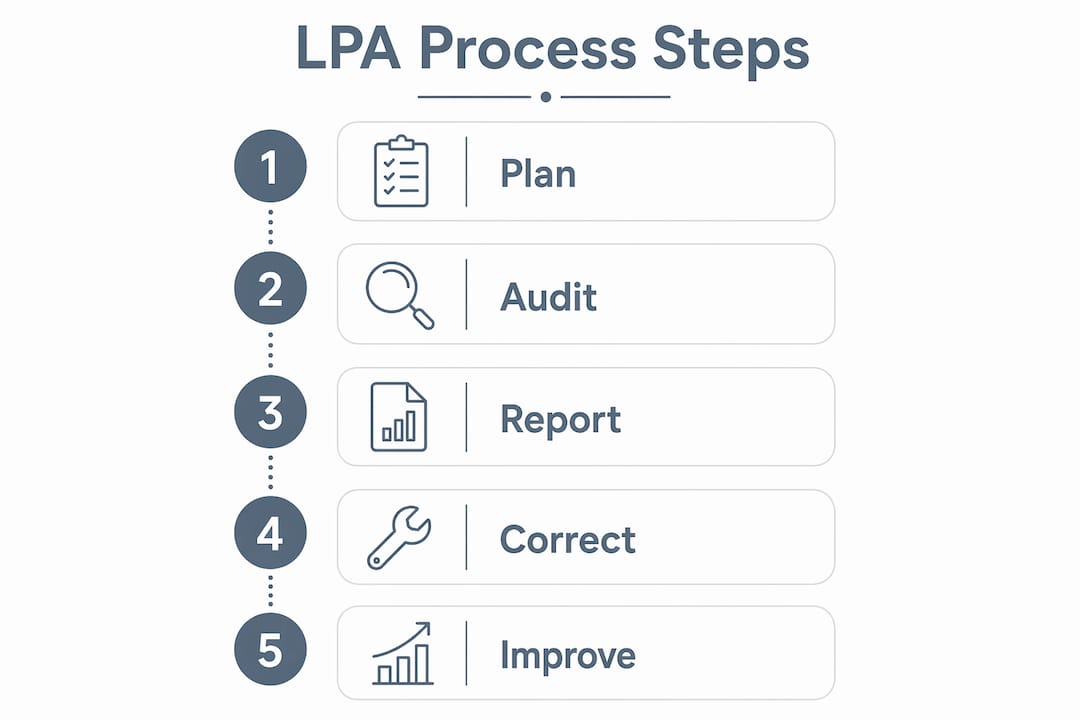
- Identify critical checkpoints. Start with process steps tied to past defects, customer complaints, or control plan requirements.
- Design the checklist. Write 8 to 12 binary, directly observable questions per session. Align each item to your standard work documentation.
- Assign layer responsibilities. Define who audits what, at what frequency, and document it.
- Build the corrective action workflow first. Assign ownership categories, escalation paths, and resolution deadlines before the first audit runs.
- Pilot on one line. Run two to four weeks on a single process, refine the checklist, then expand.
- Go digital. Paper-based systems create scheduling gaps and data integrity problems. Move to a mobile or SaaS platform early.
- Review and refine monthly. Update checklist questions to reflect new risks, closed findings, and lessons learned.
Training requirements for auditors at every layer
Auditors do not need deep quality engineering backgrounds, but they do need structured preparation. Every auditor should understand the purpose of the checklist items they are verifying, not just how to mark yes or no. A two-hour orientation covering the PDCA cycle, how to observe a process objectively, and how to document findings clearly is a practical starting point.
Layer 1 supervisors benefit from hands-on walkthroughs of their specific station checklists. Layer 2 and 3 auditors need additional context on reading trend data and escalating systemic issues. Refresher sessions every six months keep skills sharp and checklists current.
Tools and technology that make LPA execution reliable
Paper-based LPA programs struggle with scheduling complexity, low completion rates, and data integrity problems like pencil-whipping. Automated LPA software built around the AIAG CQI-8 guideline addresses all three. Digital tools reduce administrative overhead by 85–90% for audit scheduling and completion.
FloorSignal goes further by automatically parsing your existing problem reports (Word, Excel, PDF) and structuring that data into real-time dashboards. You get defect trends, station hot spots, and audit-ready historical records without rebuilding your reporting from scratch.
Measuring LPA results and driving continuous improvement
Track three metrics from day one: audit completion rate by layer, nonconformance rate by station, and corrective action closure rate. A completion rate below 90% signals a scheduling or engagement problem. A nonconformance rate of zero signals that your questions are too easy. Recurring findings at the same checkpoint signal a systemic root cause that containment alone will not fix.
Senior leader audits connect this data to broader quality management system performance, asking whether nonconformance rates are declining and whether corrective actions are closing on schedule. That connection between floor-level findings and executive-level trends is what turns an LPA program into a genuine continuous improvement engine.
Key Takeaways
Layered process audits prevent defects by verifying process inputs at every organizational level on a defined, frequent schedule, with corrective action workflows built before the first audit runs.
| Point | Details |
|---|---|
| Process-focused verification | LPAs check inputs like machine settings and operator behavior, not finished product. |
| Checklist brevity | Keep each session to 8–12 binary yes/no questions to maintain completion rates. |
| Corrective action first | Define ownership and deadlines for findings before launching the program. |
| Frequency matches risk | Higher-risk processes need tighter audit cadence at every layer, not just Layer 1. |
| Digital tools cut overhead | Automated scheduling and mobile audits reduce administrative burden by 85–90%. |
Recommended
From problem reports to plant intelligence.
FloorSignal turns the quality reports you already write into live dashboards. No new forms. No process change. Setup in days.
See your floor in 30 minutes